First Mid-Engine Sports Car: The 1960s Mustang Prototype

First Mid-Engine Sports Car: The 1960s Mustang Prototype

Ford Motor Company is famous for developing the classic American performance formula: a front-mounted engine and rear-wheel drive. The Mustang, developed in 1964, became an icon by doing exactly that: offering power, simplicity and modification potential. What history almost forgot is Ford’s experiments with mid-engine Mustangs in the 1960s. One of the projects was lost to such an extent that Ford asked the public for help in 2020. The other was also much developed: a fully driveable mid-engine Boss 429 Mustang manufactured in 1969. These projects show that Ford didn’t just think about making a Mustang with the engine in the middle. They made it and then totally forgot about it.

The Context: Why Ford Looked at a Mid-engine Layout

Today, most people connect Ford mid-engine cars with rare performance models like Ford GT or with modern rumors about a 2026 Ford Mustang. That framing makes the idea seem new and even controversial. In fact, Ford’s engineers were already looking into mid-engine layouts when the name “Mustang” was being created. In the early 1960s, Ford was actively exploring new design concepts inspired by motorsport developments in Europe. Mid-engine designs were better at distributing weight and staying stable in corners, especially in endurance racing and prototype classes. Ford didn’t want to depend only on theory or information from competitors. They wanted results right away. This initiative led to the creation of GN34 later in the 1980s. GN34 was an internal engineering prototype, a “secret” supercar, as sources claim, built to test a mid-engine Ford configuration using Mustang-inspired thinking.

What Ford Learned and Why It Walked Away

Testing reportedly confirmed what engineers expected: centralizing mass improved balance and responsiveness. From a purely technical standpoint, the mid-engine layout worked. However, those gains came with trade-offs that mattered deeply to Ford as a mass-market manufacturer: Different resources claim that testing confirmed what engineers thought: putting the mass in the center made it more balanced and responsive. The mid-engine layout worked, at least from a technical perspective. The front-engine Mustang was proving to be everything Ford needed to be affordable, flexible and successful. In this context, we might assume that mid-engine had served its purpose. The data was collected, conclusions were made and the project was quietly put away.

Technical Specs of the Mid-Engine Mustang Prototype (What We Can Say)

Unfortunately, no official factory technical specifications were saved for the mysterious 1960s mid-engine Mustang prototype. Ford itself wasn’t able to locate documentation within the company. They only found several photos of the period. Even the engineers of that time have confirmed that there was no clear record of its dimensions, powertrain or performance outputs. What we know about the “mystery” so far:
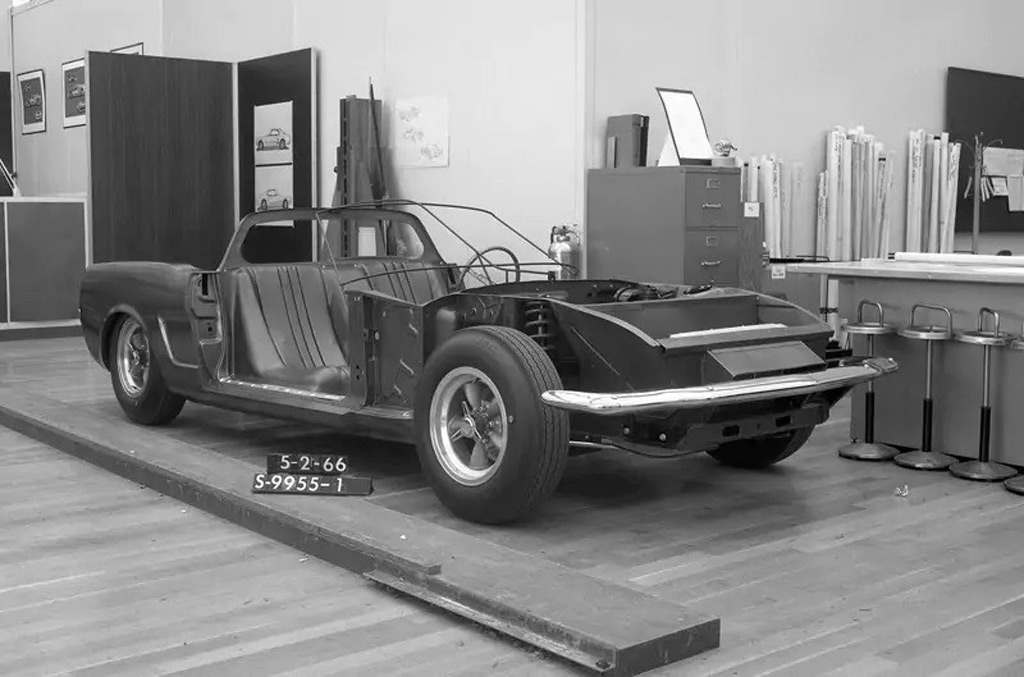
  • There are only four photos of the prototype from 1966. They show a two-seat mid-engine The images show a bare prototype shell, no instrumentation or engineering drawings.
  • Ford publicly stated they have been unable to verify most details and have reached out to the public for information.
Why there are no official specs:
  • The prototype was never part of a documented program with finalized plans, specs or internal reports archived.
  • It was an in-house experiment or design study, not a production intention. Internal files weren’t cataloged or distributed.
  • Most of the insight into this car comes from those four photos and interviews with people later asked about it. None of the individuals involved recall any hard data about it.
 
Ford GT engine location

Engine Location 

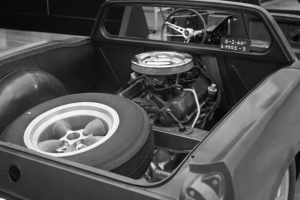
The engine is located behind the driver, which is a typical mid-engine placement (though the the exact configuration and displacement are unknown).
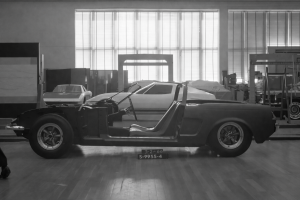
     
mustang forgotten body type

Body Style

The sports coupe has two seats with a short nose and a long cabin roofline; rear photographs show that there was space at the back of the engine bay that may have had a spare tire or cooling equipment stored.
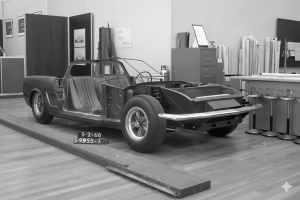
 
chassis of mustang forgotten

Chassis 

It looks like it is a prototype frame rather than a modified Mustang car. 
How the Photos Were Found

Dean Weber, the person behind Ford’s historical archives, came across the photos five years ago. Understanding their significance, Weber forwarded the images to John Clor, the Mustang author and columnist, and John Clinard, SCCA national license holder in Formula Ford, hoping that one of them might recognize the car. At first, Weber thought the car might have been reskinned to become the Mach 2 concept. Clor explored another possibility: he thought the prototype could be connected to Eugene Bordinat’s earlier Allegro design studies. Neither theory held up. Clor then reached out to some people who worked in Ford’s design studios during the 1960s, including Hal Sperlich and Gale Halderman. Sperlich believed it might be a drivable version of Ford’s mid-ship research Mustang. Halderman disagreed, saying that the mid-engine Mustang I concept was a one-off and not based on a production vehicle.

Even Ford’s Mid-Engine Experts Had No Answers

Perhaps the most telling detail is that even Roy Lunn, Ford’s engineer who was behind Ford’s mid-engine GT40 program, left no known record or explanation of the car. Lunn worked on nearly every major mid-engine Ford project of the era. If anyone knew the origins of this Mustang, it would have been him. If he did know, that knowledge was never documented, and unfortunately, he passed away in 2017.

Ford’s Reach to the Public for Help (2020)

By 2020, the secret of the mid-engine Mustang had hit the wall within Ford itself. Years of internal outreach to current and former employees, designers, engineers and executives in the 1960s did not give Ford answers. In 2020, Ford took an unusual step: they asked the public for help. As part of the effort, Ford released black-and-white photos from May 2, 1966. They showed the mid-engine Mustang prototype inside a Ford design studio. The company openly admitted that there were no internal documents or firsthand reports that could explain who ordered the car, who worked on it. how far along development was or why the project was canceled. Ford asked that anyone who knows something about the prototype, including former employees, contractors or their families, come forward and reach out via the provided email address. With the 2020 request, one thing became obvious: it was not a case of selective corporate narrative. Ford truly didn’t know the full history of its car. The mid-engine Mustang had not only disappeared from public awareness, but it had also gone from Ford’s own “institutional” memory.

What Happened After 2020?

The mystery was solved within the same week Ford made their public request. Here’s how it came together. Ted Ryan, Ford’s Archives and Heritage Brand Manager, assigned reference archivist Jamie Myler to investigate the case. Ryan had access to tens of thousands of pictures from the Ford Design Studio, which are referred to as “styling negs” (negatives) because traditionally these design works-in-progress were stored as negatives. Unfortunately, the original inventory for these photographs had been lost in a flood. Out of 350,000 styling negatives still in cold storage, only 50,000 had been scanned. Ryan reached out to Jim Farrell, who had written a book about the Ford Design Department and had access to Ford’s collection of S-negative photos. Farrell sent the photos to 13 designers or clay modelers who were at Ford in 1966. Bud Magaldi, a designer who got to Ford in June 1966, called and confirmed the car was related to the Mach 2, saying the chassis was started in 1966 and took time to get everything right. Magaldi told that the car was done by Larry Shinoda in a small basement studio in secret, with Jerry Morrison as another designer involved and Bob Huzzard as the studio engineer. The mystery car was confirmed as an engineering study of a packaging version that later on became the 1967 Ford Mach 2 mid-engine concept. The Mach 2 body was later recreated using fiberglass. This is the reason why the final car did not have any traces of the Mustang body as shown in the 1966 pictures.